
Volume 4, Issue 3 (2026) Spring 2026
Dear Reader,
On behalf of Dr. Boyd Bradbury, our Editor-in-Chief, the Associate Editors, Review Board, and Editorial Board members, I welcome you to Volume 4, Issue 3 of the Interactive Journal of Global Leadership and Learning (IJGLL). This issue is comprised of six research articles and four white papers. This scholarly work discusses a variety of leadership issues pertaining to K-12 (i.e., social justice, data literacy, teacher retention, reading instruction), higher education (i.e., program preparation continuous improvement practices, unbiased research procedures), and the process of regaining control over our own existence (i.e., recovery, stress).
Carl Bryan, one of our most prolific contributing authors, has written two white papers. The first, Emotional Sobriety as Liberation: A Critical Pedagogy of Resilience, is a piece that builds on Reclaiming My Story (Bryan, 2026), in which healing was framed as a Freirean act of reclaiming authorship through naming harm, dialogue, and praxis. In Emotional Sobriety as Liberation, Bryan formulates how reclaimed consciousness is sustained under ongoing emotional, relational, and structural strain, reframing post-trauma survival not as incomplete recovery but as ongoing praxis. Bryan’s second contribution, Re-Reading the World: Why Critical Literacy Must Accompany the “Back to Basics” Movement, is a call for positioning literacy as both a “technical skill and a social practice, instrumental to identify and fight misinformation, addressing inequities, and fostering democratic participation.” Bryan reminds us of the critical role that literacy play in contributing to children and adults more profoundly understanding the world in which they live and developing tools for transformation. Dr. Carl Bryan works at the Wisconsin Department of Public Instruction.
Heather Dunham, an assistant professor of education at the University of Louisiana at Lafayette, writes From Framework to Praxis: An Examination of Integrated Comprehensive Systems (ICS) Equity Reform and Black Student Engagement, a qualitative case study investigating a racially diverse Midwestern middle school that had implemented the ICS framework to impact outcomes for Black students. Durham’s findings highlight the transformational role of leadership practices in informing “leadership preparation programs seeking to operationalize equity through systems-level change.”
In her study, Breaking the Mold: An Examination of Student Perceptions with Faculty-Led Native American Student Research Experiences, Caitlin Johnson shares details of her role as “faculty advisor guiding students through an immersive Indigenous research journey,” a journey that afforded meaningful research learning opportunities for indigenous college students. This experience contributed to addressing the existing research equity gap that impacts academia as well as the knowledge it yields. Dr. Caitlin Johnson is an assistant professor of education at Minnesota State University Moorhead.
Jenny Maras' first contribution to the IJGLL is Building Minnesota's Teacher Workforce from Within: Policy Recommendations to Expand Grow Your Own Teacher Pathways in Minnesota, a white paper highlighting Jenny’s commitment to exploring solutions that effectively address long-term educator retention. Jenny Maras is the Program Director for Teacher Recruitment and Retention with Minnesota Career and Technical Education (MN CTE) and Lakes Country Service Cooperative (LCSC) and an educational leadership doctoral student.
Tevia Strand contributes a white paper focused on Preparing Teachers to Read the Data: Strengthening Data Literacy for Early Literacy Decision-Making. This is a core component of Tevia’s research agenda, which examines the existing gap between teacher preparation and the realities of K-12 data collection and usage. Attention is placed to “early literacy decision-making and reflecting on whether sufficient preparation to interpret assessment data or connect benchmark patterns to instructional action is provided in educator preparation programs.” Tevia Strand currently serves as a K–5 reading specialist and a Multi-Tiered Systems of Support (MTSS) coordinator in Minnesota and an educational leadership doctoral student.
Monica Weir contributes significantly to the improvement of educational leadership doctoral program evaluation practices. Her piece, Embedding Evaluation for Continuous Improvement in a Cohort-Based Doctoral Residency Model: Evidence from an Ed.D. Program, is a valuable review of a “practical model for embedding evaluation to guide iterative improvement in cohort-based doctoral programs.” Dr. Monica J. Weir is Head of Mathematics at Agora Barcelona International School in Spain.
Laurie Wolfe and Rakhmatullo Akhmedov have written Exploring Stress and Mindfulness in Central Asia: Perspectives of English Language Students in Uzbekistan. This is a study that “explores how Uzbek university students understand and experience stress, identifies the primary sources of stress in their daily lives, and examines their perceptions of mindfulness as a potential stress‑reduction strategy.” This study adds to the literature identifying stress as a universal experience. Dr. Laurie A. Wolfe is a Professor of Psychology and former Fulbright U.S. Scholar. Rakhmatullo Akhmedov is a counseling graduate student and works at the US Embassy in Tashkent, Uzbekistan.
David Wolff, Melissa Wolff, and Mark Diacopoulos embarked on Collaborating with our AI Research Companion: Exploring the Use of Microsoft Copilot to Conduct Inductive and Deductive Coding in Qualitative Research, which was written to discuss the use of Generative Artificial Intelligence (GAI), specifically Microsoft Copilot, as an analytic tool in the qualitative data analysis process. This piece will greatly resonate with the many faculty currently exploring the AI possibilities within the research ecosystem.
David Wolff, Scott Klimek, and Elizabeth Dale explored how various education topic were perceived by pre-service teachers regarding their degree of importance and urgency. The findings provide insight into the current priorities and concerns of future teachers, aiming to enhance the relevance and effectiveness of teacher preparation programs to ensure teacher readiness during their first year in the profession.
I am confident that you will find beneficial the work of these authors.
Sincerely,
Ximena Suárez-Sousa, Ph.D.
Managing Editor
Articles
From Framework to Praxis: An Examination of Integrated Comprehensive Systems (ICS) Equity Reform and Black Student Engagement
Heather L. Dunham
Breaking the Mold: An Examination of Student Perceptions with Faculty-Led Native American Student Research Experiences
Caitlin A. Johnson
Embedding Evaluation for Continuous Improvement in a Cohort-Based Doctoral Residency Model: Evidence from an Ed.D. Program
Monica J. Weir
Exploring Stress and Mindfulness in Central Asia: Perspectives of English Language Students in Uzbekistan
Laurie A. Wolfe and Rakhmatullo Akhmedov
Collaborating with our AI Research Companion: Exploring the Use of Microsoft Copilot to Conduct Inductive and Deductive Coding in Qualitative Research
David Wolff, Melissa Wolff, and Mark Diacopoulos
Listening to Learn: Preservice Teachers’ Voice on What Matters Most in their University Preparation Programs
David Wolff, Scott Klimek, and Elizabeth Y. Dale
White Papers
Editors
- Boyd Bradbury, Ph.D.
- Editor-in-Chief
- Ximena Suarez-Sousa, Ph.D.
- Managing Editor
Cover Art
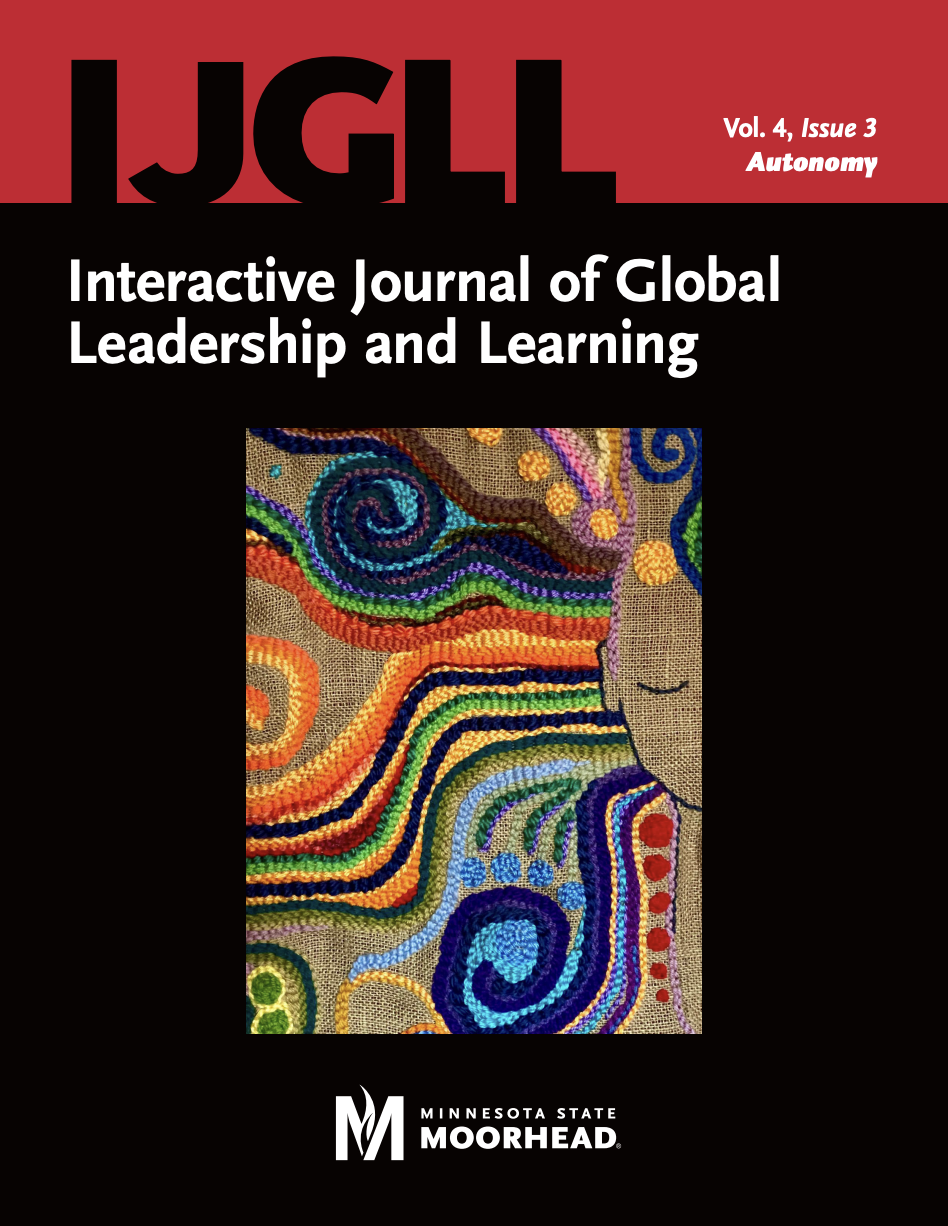
- "Autonomy"