
Volume 4, Issue 2 (2025) Fall 2025
Dear Reader,
On behalf of our Editor-in-Chief, Associate Editors, Review Board, and Editorial Board members, I welcome you to Volume 4, Issue 2 of the Interactive Journal of Global Leadership and Learning (IJGLL). This issue is comprised of five research articles and one white paper. This body of scholarly work significantly contributes to the aims and scope of our journal by focusing on issues pertaining to online higher education, leadership and crisis, and social justice.
Agkul, Brown, and Suomala Folkerds used a phenomenological study to explore the lived experiences of recent graduates from a HyFlex/Hybrid CACREP-accredited counseling program. This study addresses a critical gap in the online and hybrid higher education literature by focusing on the often-overlooked area of counselor preparation.
Carl Bryan, author of the white paper, offers a raw and intimate account of his trauma recovery process. Inspired by the works of Freire (1970/2018), hooks (2000), and Giroux (2010), Bryan writes not only as an academic, but as an individual seeking healing necessary to reclaim his life. He proposes a Critical Pedagogy of Healing, a framework encompassing reflection, dialogue, and action to foster both personal soulful healing and broader social change.
Durham situates the study within schools implementing practices to disrupt racial inequities. Rather than focusing on leadership per se, the author explores teacher perceptions and phenomenology concerning their roles as disruptors and co-leaders who sustain spaces that nurture, advocate, and model social justice for all.
Utilizing a conceptual synthesis procedure, Kent formulates a Post-Pandemic Rural Leadership framework characterized by resilience. This framework has significant implications for state agencies, educational leader preparation programs, and policymakers. The author states that the post-pandemic period demands “the cultivation of new forms of leadership that center on people, adaptability, and care.” A framework that will undoubtedly serve as catalyst for further research.
Strand explored undergraduate students’ perceptions of campus mental health services, comparing the two predominant delivery models in American colleges: integrated care and standalone counseling. By examining how these models influence the likelihood of reported social stigma and other emerged themes, the author provides actionable recommendations for enhancing service impact.
Wolff, Wolff, and Diacopoulos conducted a self-study focusing on a married couple of professors who accepted teaching positions at their respective alma maters during the same academic year. This exploration follows the authors as they return to their academic roots and face challenges associated with identity dissonance. The methodology is supported by a critical partner who acts as a sounding board, providing objective feedback and critical dialogue.
I am confident that the scholarly work of these authors will prove beneficial to you.
Sincerely,
Ximena Suárez-Sousa, Ph.D.
Managing Editor
Articles
Voices from the HyFlex Classroom: Understanding the Graduate Counseling Student Experience
Taryn Akgul, Jessica Brown, and Aaron Suomala Folkerds
Voices from the Other Side: Leadership Practices Teachers Value for Equity Systems Change
Heather L. Dunham and Heather Dunham
Models of Care in Higher Education: Comparing Integrated and Standalone Approaches to Student Mental Health
Tevia Q. Strand
Returning to Roots: A Self-Study of Married Faculty Transitioning to Faculty Roles at Alma Maters
David Wolff, Melissa Wolff, and Mark Diacopoulos
White Paper
Editors
- Boyd Bradbury, Ph.D.
- Editor-in-Chief
- Ximena Suarez-Sousa, Ph.D.
- Managing Editor
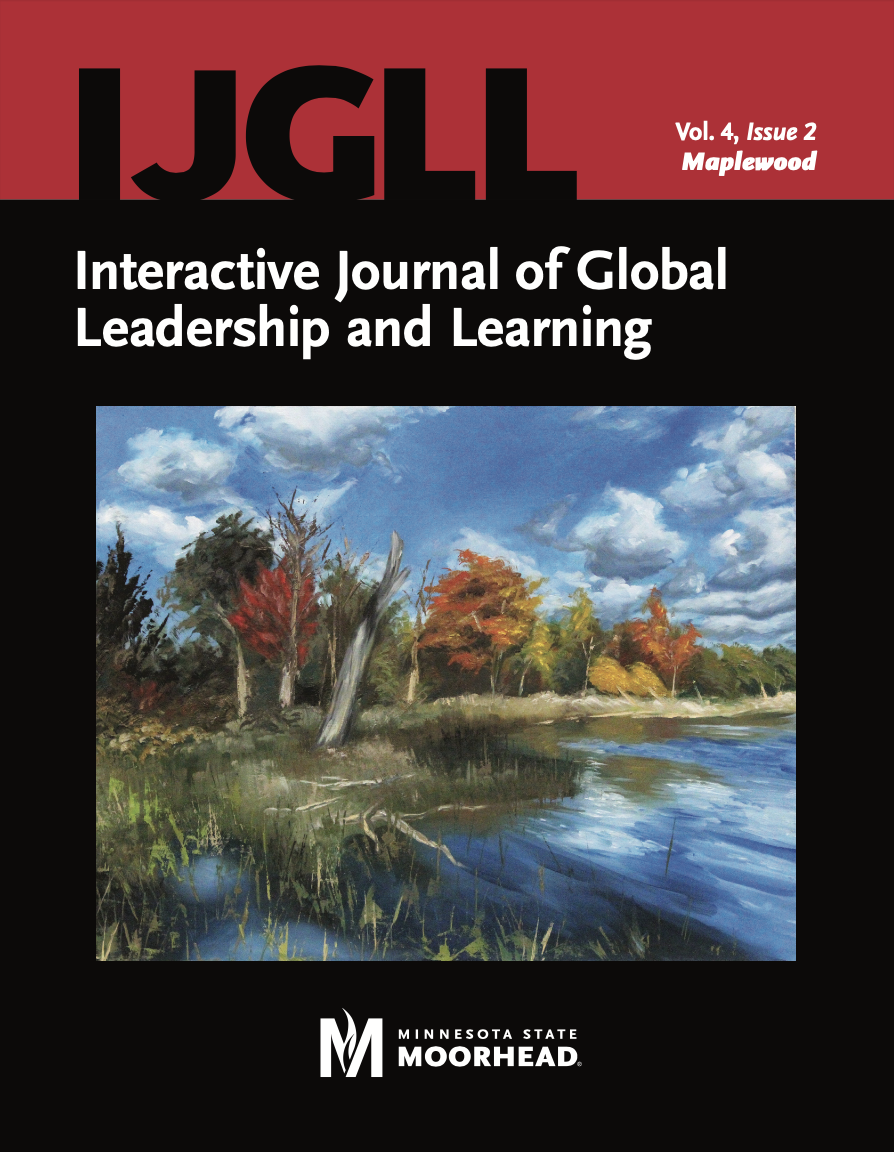
Cover Art
- "Maplewood"
- By Michelle Zidon
- MSUM Art Education student
- Visit MSUM School of Art